


Ebook Seeing and Believing: How the Telescope Opened Our Eyes and Minds to the Heavens, by Richard Panek
Reading ends up being even more value and significance in the life cultures. It has the tendency to be a lot more intricate. Every aspect that undergoes the life will entail reading. Reviewing can be reading every little thing. In the way, market, library, publication shop, web sources, lots of will certainly reveal you advantages when reading. However, it's even more finished when publication can be your favourite term to check out. We will certainly share Seeing And Believing: How The Telescope Opened Our Eyes And Minds To The Heavens, By Richard Panek that could make you fall in love to review.
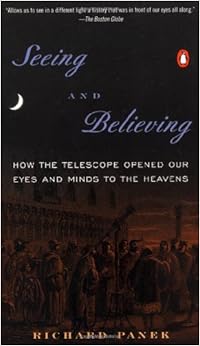
Seeing and Believing: How the Telescope Opened Our Eyes and Minds to the Heavens, by Richard Panek

Ebook Seeing and Believing: How the Telescope Opened Our Eyes and Minds to the Heavens, by Richard Panek
Seeing the library every day could not become your design. You have many works and also tasks to do. Yet, you need to look for some analysis books, from literary to the national politics? Exactly what will you do? Favoring to get the book occasionally when you are associating pals to guide shop is suitable. You can search as well as discover the book as you such as. But, what concerning your referred publication is not there? Will you walk once more as well as do browse as well as find any more? In some cases, lots of people will be so careless to do it.
Well, one of the efforts to enhance the experience and knowledge is by analysis. You recognize, checking out publication, especially, will guide to understand brand-new point. When you do not know regarding what you intend to carry out in your work, you could start by reading the book. When you repent to ask for a person, you can have the book to review. Whatever the book is, it will certainly constantly offer the compassion. To assist you discover your brand-new effort, this Seeing And Believing: How The Telescope Opened Our Eyes And Minds To The Heavens, By Richard Panek may be good.
Maturing from primary to the adult, reviewing books will certainly let different reasons to believe. Sometime, we require the book as a result of the work target date. Yet in various other time, you could check out once again this Seeing And Believing: How The Telescope Opened Our Eyes And Minds To The Heavens, By Richard Panek, for not only the job target date requirement however also for excited. So, reads this publication your wonderful excited to read. When you have sufficient to seek for one more book that can't make you feel happy, you will always look for various other resources, will not you? This is why we come to you in order to help in locating the right publication.
For even more interesting reason, you may not know concerning the content of this book, may you? Why don't you aim to understand? Understanding brand-new thing will bring about conceptualize the life better. You could not only review as the tasks, yet reading can be a method to make your life run well. By this Seeing And Believing: How The Telescope Opened Our Eyes And Minds To The Heavens, By Richard Panek you could actually visualize how the life will certainly be and also should be.
About the Author
Richard Panek has written about astronomy and science for the New York Times, Natural History, Esquire, and Outside. He is also a PEN Award-winning fiction writer whose short stories have appeared in Ploughshares and on National Public Radio. He lives in New York City.
Read more
Product details
Paperback: 208 pages
Publisher: Penguin Books (October 1, 1999)
Language: English
ISBN-10: 0140280618
ISBN-13: 978-0140280616
Product Dimensions:
4.6 x 0.6 x 7.5 inches
Shipping Weight: 5.6 ounces
Average Customer Review:
4.4 out of 5 stars
8 customer reviews
Amazon Best Sellers Rank:
#563,107 in Books (See Top 100 in Books)
A great read. Highly recommend to anyone into astronomy and the history of the telescope!
I've read a lot of books about telescopes and the history of astronomy so I was somewhat skeptical that this small format text from 1998 would be all that interesting. But it only took a few pages' reading to realize that this book was something special. It is not a bare bones recital of the standard history you read in other books, where other books summarize Galileo and the telescope in a sentence or two and then move on, Panek devotes about a 1/3 of the book to what happened *after* Galileo made his telescope but *before* the next advance in telescope design. What happened was that astronomers changed their whole way of thinking about the universe, starting with convincing themselves that the image in the telescope was actually a reality, and not some distortion of their vision. When refracting telescopes were improved later, astronomers dismissed them because the image was upside down! It was only years later that they realized it didn't matter in astronomy what was up and what was down. I've never read about this in any other books.In addition to an in-depth study of the Galileo period, William Herschel gets a large portion of the book. This is also fascinating and new because most books mention his work (a huge star catalog, discovery of Uranus), but little about the man himself. It's interesting to see here how a musician giving 8 lessons a day becomes the astronomer to the king.Lastly Hale and Hubbard get their due. Again with more insight into Hale than I've gotten out of hour-long documentaries on TV.It helps to have been exposed to some of this material elsewhere, since this book had no illustrations or photos. But it certainly fills in some gaps in history that you will find interesting.
Wow...some of those lights are actually ...other Earths? Galileo and his contemporaries opened up the door for people to confirm what they've read in scripture and to get, for the first time, perspective on *size* and *distance*.Suddenly the moon had a very "lined" countenance and Mars was a different color from the moon. And the starry backdrop begged the question: does intensity of light betray closeness?Hubble is the new "basic" telescope. And we still can only see a tiny spec from which to guess on the size of this mess. If we can say there are an approximate umber of stars in this part of the picture, then what of *the* picture? And are there countless pictures?Read this poetic..but not *easy* book. Just like the early views into space - it requires reflection.
If you've read "Longitude," by Dava Sobel, and liked it, you'll like Panek's book as well. "Longitude" is the story of the invention of a chronometer sufficiently accurate to allow navigation to a desired longitude. It was instrumental in the mapping and exploration of earth. Similarly, "Seeing and Believing" is the story of another important invention, the telescope, which allowed us to map the cosmos and, as the subtitle says, find our place in the universe.The story of the telescope begins with glass. More than 100 years before the invention of the telescope people fashioned glass into lenses that corrected poor eyesight, and found practical applications in such things as reading spectacles. It seems odd, I think, that it took so long for someone conceive of using two lenses in a tube to magnify the appearance of distant objects. [Then again, most things seem trivial in hindsight. Original thought is often underrated, and what we mistake as intelligence is often nothing more than the common man's ability to learn tricks taught by genius.]Most of us have heard of Galileo. He is famous for his use of the telescope, and for his confrontations with the Catholic Church. But Galileo wasn't the inventor of the telescope (though he made significant contributions to the telescope's design). Galileo's genius was in the way he used the telescope to study the heavens, the conclusions he drew from those observations, and how those observations began a scientific and philosophical revolution that emphasized experimentation as the foundation of science.Before the invention of the telescope the idea hadn't yet been hatched that an instrument could bring distant, essentially invisible, objects into clear view. There were initial suspicions that the telescope was just an elaborate hoax; an optical illusion. This suspicion was aided by design flaws in early telescopes that resulted in large optical aberrations, especially near the edges of the lenses. Placing myself in this historical context I find a certain amount of empathy for the skeptics. But it was overdone. Even when the telescope proved its validity through unambiguous verification, by demonstrating the ability to discern distant terrestrial objects, there was still a suspicion that it might view celestial objects with less accuracy. Old ideas die hard.It wasn't just healthy skepticism that resulted in initial criticism of celestial observations with the telescope. These observations were diametrically opposed to the philosophical constructs of the day. What these observations showed us was the picture of a universe that was utterly inconsistent with those favored by the religious and philosophical leaders of the day. Eventually, though, even religion couldn't stop the march of progress. The telescope's utility and its power to challenge belief by seeing (as the old saying goes, seeing is believing) led to a revolution not only in our understanding of the cosmos, but the observational bedrock of modern science itself.A good part of the book takes us up through the story of Galileo, but it doesn't end there. Other astronomers used the telescope to continue to expand our view of the universe. The story has been a rapid one. It wasn't that long ago (within the last century) that scientists weren't sure if the galactic nebula were clouds or groups of stars. Our local galaxy, the Milky Way, was no different. Within the last 100 years the telescope has been at the forefront of a revolution that has expanded the size of the known universe billions of light years and brought into view strange new phenomena like dark matter, black holes, neutron stars, and super novae.Today's modern telescopes are very different, yet much the same, as the one Galileo first peered through. They are monumental instruments of incredible complexity. Optical telescopes are huge behemoths that use compound mirrors with active focusing to compensate for thermal currents in the earth's atmosphere. Other telescopes, like Hubble, look outside the obscuring atmosphere for an uncluttered look at the universe. Still others explore the universe at very long (infrared) wavelengths, microwave wavelengths, and even radio wavelengths. While they do, a new generation of telescopes, like the European Space Agency's (ESA) XMM-Newton X-ray satellite, explores the universe at wavelengths indicative of the most violent activity in the universe.Though different in almost all their mechanical respects, modern telescopes do one thing essentially the same as Galileo's instrument; they open up the universe to our view and explode many of our pre-existing concepts about the universe. And, perhaps most importantly, they guide our quest to understand our place in the universe.This is a small book with a surprising amount of information within its pages. It can be read easily in a week, and it's small enough to carry to the park or library. The book is easy to read, very well written, entertaining and informative. I thoroughly loved it.
Seeing and Believing: How the Telescope Opened Our Eyes and Minds to the Heavens, by Richard Panek PDF
Seeing and Believing: How the Telescope Opened Our Eyes and Minds to the Heavens, by Richard Panek EPub
Seeing and Believing: How the Telescope Opened Our Eyes and Minds to the Heavens, by Richard Panek Doc
Seeing and Believing: How the Telescope Opened Our Eyes and Minds to the Heavens, by Richard Panek iBooks
Seeing and Believing: How the Telescope Opened Our Eyes and Minds to the Heavens, by Richard Panek rtf
Seeing and Believing: How the Telescope Opened Our Eyes and Minds to the Heavens, by Richard Panek Mobipocket
Seeing and Believing: How the Telescope Opened Our Eyes and Minds to the Heavens, by Richard Panek Kindle

Tidak ada komentar:
Posting Komentar